

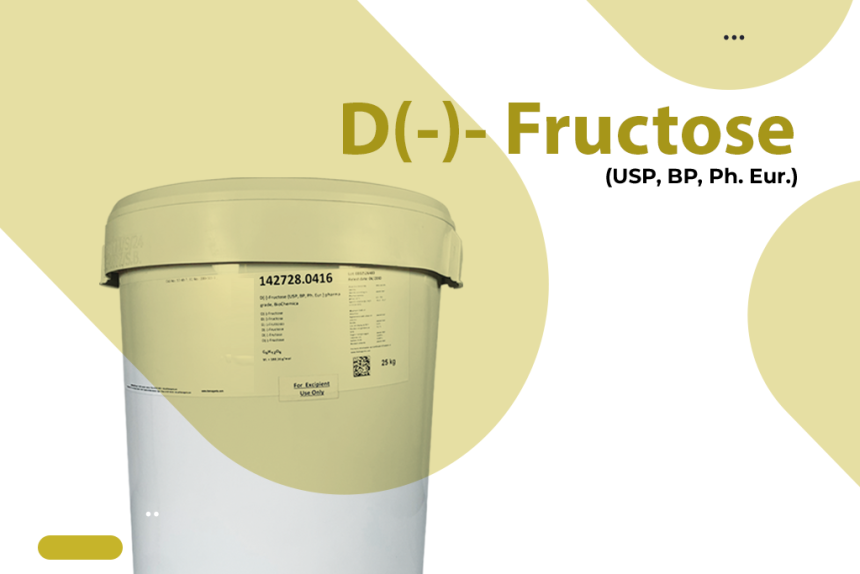
This simple sugar, naturally occurring in fruits and honey, is being increasingly adopted in the pharmaceutical industry for its ability to enhance product stability, mask unpleasant tastes, and improve patient compliance.
Understanding D(-)-Fructose and Its Unique Characteristics
D(-)-Fructose, also known as levulose, is a monosaccharide with a naturally sweet taste that is significantly sweeter than sucrose. Its unique molecular structure allows it to interact with active pharmaceutical ingredients (APIs) in a way that preserves their integrity over time. Unlike some synthetic sweeteners, D(-)-Fructose is metabolized naturally in the body, making it a safer choice in formulations intended for sensitive patient groups, including pediatrics and geriatrics.
Applications in Pharmaceutical Formulations
The primary use of D(-)-Fructose in pharmaceuticals is as a sweetening agent in syrups, chewable tablets, lozenges, and oral suspensions. It effectively masks the bitterness of many APIs, ensuring a more palatable dosage form for patients. Furthermore, its hygroscopic nature makes it ideal for stabilizing moisture-sensitive drugs, maintaining their potency throughout the product’s shelf life.
In addition, D(-)-Fructose is frequently incorporated into nutritional supplements and oral rehydration solutions (ORS) due to its rapid absorption and energy-providing properties. Its compatibility with vitamins, amino acids, and electrolytes makes it a versatile component in multi-ingredient formulations.
Role in Stability and Shelf Life
One of the standout qualities of D(-)-Fructose is its contribution to formulation stability. By reducing water activity within a product, it helps minimize microbial growth and chemical degradation of APIs. This stability-enhancing property is particularly important for liquid and semi-solid formulations that require extended shelf life without refrigeration.
Moreover, D(-)-Fructose has the ability to form complexes with certain drugs, protecting them from oxidation or light-induced degradation. This function makes it especially valuable in sensitive formulations such as vitamin blends, plant extracts, and biologically active compounds.
Industrial-Scale Production and Quality Standards
Pharmaceutical-grade D(-)-Fructose is typically produced through the enzymatic isomerization of glucose derived from starch sources such as corn. This process ensures high purity levels, eliminating unwanted by-products that may interfere with drug performance. Manufacturers follow stringent quality guidelines, including pharmacopeia standards such as USP, BP, or Ph. Eur., to ensure the product meets strict safety, identity, and purity requirements.
Consistency in particle size, solubility, and pH are critical quality attributes for D(-)-Fructose in pharmaceutical applications. The material undergoes rigorous analytical testing, including infrared spectroscopy, moisture analysis, and chromatographic purity checks before approval for use.
Future Outlook and Innovation
As patient-centric drug development continues to grow, excipients like D(-)-Fructose will remain at the forefront of formulation science. Its natural sweetness, safety profile, and stability-enhancing properties align well with the current demand for clean-label pharmaceutical products. Researchers are also exploring its role in controlled-release systems, where D(-)-Fructose can serve as a matrix material to regulate drug release rates.
With advancements in biopharmaceuticals and personalized medicine, the versatility of D(-)-Fructose will likely expand, making it an indispensable tool for formulators aiming to balance efficacy, safety, and patient acceptability.